Die Gäste des Hotels Yado-Shiontei sagen Folgendes: For our annual pilgrimmage to the West coast of Japan during Zuwai-gani (Red Snow Crab) season, we decided to visit Yonago in Tottori Prefecture. While Tottori is technically part of San'in/Sanyo, which also includes Shimane, Yamaguchi, Hiroshima and Okayama), for Snow Crab purposes it's the South/Westernmost area that offers this crab delicacy (Ishikawa Prefecture is the North/Eastern boundary for this type of crab that experts consider legit, at least in taste.) Within the Snow Crab region, they have different names - Kano-gani (Ishikawa Prefecture), Matsuba-gani (Hyogo, Kyoto, Tottori), Echizen-gani (Fukui), and in some cases they are further broken down into sub-brands (Taiza, Tsuiyama, Kasumi, etc.) We were intrigued about the idea of visiting Yado Shiontei - it opened in 2021 to wide acclaim, and commands a price that matches that of Bouyourou in Fukui Prefecture, and is about double the per-person nightly rate of Nishimuraya Honkan. All in all, we were glad to have tried it out, but if we were to judge ryokans strictly on the merits of the Zuwai-gani courses, in my mind Nishimuraya still reigns supreme.
Yonago is located along the Sea of Japan coast on the Western edge of the Prefecture, bordering Shimane, and is Tottori's capital and largest city. It's not a heavily visited region by Westerners, but there are some major attractions nearby - the imposing Matsue Castle is one of only 11 castles that have its main tower intact from feudal times, and the surrounding area is a well preserved feudal-era castle town and is a charming area to explore. Izumo Taisha is one of the most ancient and important Shinto shrines in the country, and hosts two major festivals every year. The Adachi Museum of Art has an award winning garden that has been named the best garden in Japan every year since 2003 from the Journal of Japanese Gardening. Soaring from sea level to 1729 meters at the top, the charismatic Mt. Daisen is the holiest mountain in the region and has an abundance of activities for visitors wishing to enjoy nature.
Kaike Onsen, a small area within Yonago, gets its name from the type of spring water that can be drawn from the resort area. It's a rare saltwater hot spring which was supposedly discovered in the early 1900s by a fisherman who was said to have spotted bubbles rising from the ocean floor about 200 meters off the coast. Kaike Onsen is considered a pioneer in Thalassotherapy, and it's considered to be beneficial to one's health. We're always up for trying different types of onsen, so the fact that Yado Shiontei offered a unique bathing experience was a nice bonus.
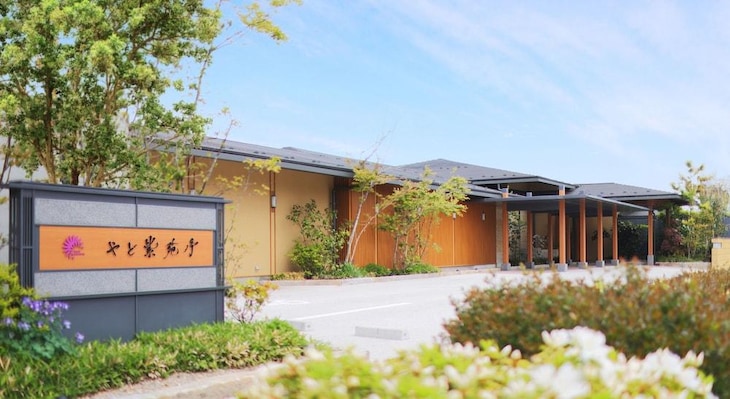
The 10-room ryokan is in the middle of Yonago, and it's located on a main street surrounded by bland buildings; Yado Shiontei didn't scream "luxury" as we approached it, but inside it's an oasis of tranquility. It's a modern Japanese build with (mainly) Japanese design; it was right up Mrs. KI-NRT's alley. It's built to a very high quality, and nice little touches abound - Ikebana flower arrangements, small inner dry rock gardens and even a little public tea room at the intersection of two guest room corridors. Yado Shiontei has a dedicated gallery featuring works from "Ningen Kokuho" (Humans officially deemed as "National Treasures".) Overall, it's a wonderful atmosphere, even if the grounds are not particularly expansive.
At Yado Shiontei, we would not mind staying in any of the rooms, as all of them are true suites and have in-room Onsen. The ryokan does not have a Daiyokujo (communal bath), only has one private rental bath. We decided to reserve the rental bath in advance, despite its high price - we later learned that we had the private bath for our exclusive use for the entirety of our stay, which was unnecessary.... it was not any larger or more impressive than the onsen in our room. We did book one of the two "Kihinshitsu" (special rooms) and opted for Reirou, which was preferable to Kuon due to the latter being (slightly) less contemporary and having a couch that was Edwardian-era in design (no thanks!) Also, Reirou was at the very end of the corridor, so we never heard any footsteps during our time in the room. Otherwise, they were the same, 150m², didn't share a wall with neighboring rooms and featured both and indoor and outdoor Kaike Onsen bath. In case you're wondering - yes - the bedroom can be completely sealed off from the living room via sliding doors; this is not an unusual feature in many luxury ryokan rooms.
We dined in one of the 5 koshitsu (private rooms), and overall, we came away satisfied but couldn't get Nishimuraya Honkan out of our minds. It's hard to pinpoint the exact differences, but Nishimuraya was established in the Edo period (1854, to be exact) and is in its 7th generation of ownership, so perhaps they've had more time than others to define/refine their cuisine? And it's not just the crab - we've had acquaintances visit Nishimuraya in the Summer months and raved about the kaiseki meals there. In any case, at Yado Shiontei they did a nice job of bringing the best out of the succulent Matsuba-gani, and the other small, non-crab dishes were also delightful. One of the memorable offerings was the "Matsuba Gani Koura Zake," where the crab head is first grilled on the shell, then cooked with sake poured inside of it. It's consumed once the sake is brought to a boil. The flavors of the crab tomalley, combined with the warm sake was amazing. One thing to note about Zuwai-gani timing, according to the head chef at Yado Shiontei: the best time to go depends on your own taste. In general, earlier in the season (November), when the water is warmer the crab meat is softer. Later in the Winter, the crab meat becomes more firm and plump. It's really a matter of preference; the chef said that it's a 50/50 split among conoisseurs that prefer one over the other.
Just because we think Nishimuraya Honkan is tops doesn't mean we'll be going there every single year. Other ryokans in other locations have unique aspects that we'd like to experience.
If crab is not a priority - or you visit the area when crab is not in season - Yado Shiontei is almost certainly the top luxury ryokan option in Tottori. We wouldn't mind paying another visit to sample their non-crab kaiseki course, which supposedly makes great use of the bountiful harvest from the land (especially with the fertile soil from nearby Mt. Daisen) and sea.








 Glückwunsch! Sie wissen wie man gute Angebote sucht


Ausgezeichnet
Basierend auf 1 Bewertungen
Anzeige von 1 ausgewählten Bewertungen von 1 Bewertungen von Tripadvisor
K
KI-NRT
Ashiya, Japan
10/06/2025
“Top-notch luxury in Tottori Prefecture; crab was good but not the best”
For our annual pilgrimmage to the West coast of Japan during Zuwai-gani (Red Snow Crab) season, we decided to visit Yonago in Tottori Prefecture. While Tottori is technically part of San'in/Sanyo, which also includes Shimane, Yamaguchi, Hiroshima and Okayama), for Snow Crab purposes it's the South/… Mehr
Die gezeigten Bewertungen wurden nicht überprüft. Viajes El Corte Inglés, S.A. gewährleistet weder, dass diese Bewertungen echten Nutzern des Dienstes entsprechen, noch ist sie für deren Inhalt verantwortlich. Mehr Informationen